

Spain lifted the trophy. Argentina dominated the online conversation. NewsVibe’s analysis of more than 76,000 mentions shows that Spain won the trophy and the positive narrative, while Argentina remained the center of the conversation and the main negative driver among the two finalists. Messi continued to receive strongly positive individual coverage across online sources, while politics, refereeing and incidents transformed the final into a total media event. The analysis is based on mentions published during the period under review across approximately 20,000 online sources in 75 countries spanning every region of the world.
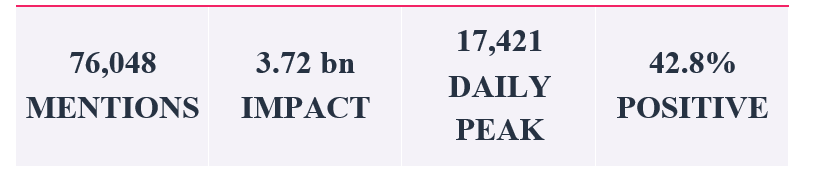
Between July 13 and 20, 2026, the online conversation around the World Cup generated 76,048 mentions and a combined potential impact of more than 3.72 billion across the web, Facebook, YouTube and TikTok sources monitored by NewsVibe. Spain’s 1-0 victory over Argentina, sealed by Ferran Torres’s extra-time goal, delivered a clear sporting outcome. The media narrative, however, was far more complex: Spain dominated the victory frame, Argentina remained at the center of the conversation, Lionel Messi continued to attract overwhelmingly positive sentiment, while politics, refereeing and incidents generated the main pockets of negativity.
A World Cup final is no longer just a match; it is a fully fledged media ecosystem. The result on the pitch, fan reactions, the players’ public image, political protocol, controversies and personal stories all develop simultaneously and compete for visibility.
The final’s echo outgrew the match itself
The volume trend reveals a week in three acts. The semi-finals produced the first peaks, with 10,404 mentions on July 15 and 10,178 on July 16. A holding pattern followed on July 17-18, before the final lifted the volume to 10,717 mentions on July 19.
The maximum was not reached on match day, but on July 20, when NewsVibe identified 17,421 mentions – 62.6% more than on the day of the final. Together, those two days accounted for 37% of the entire volume analyzed.
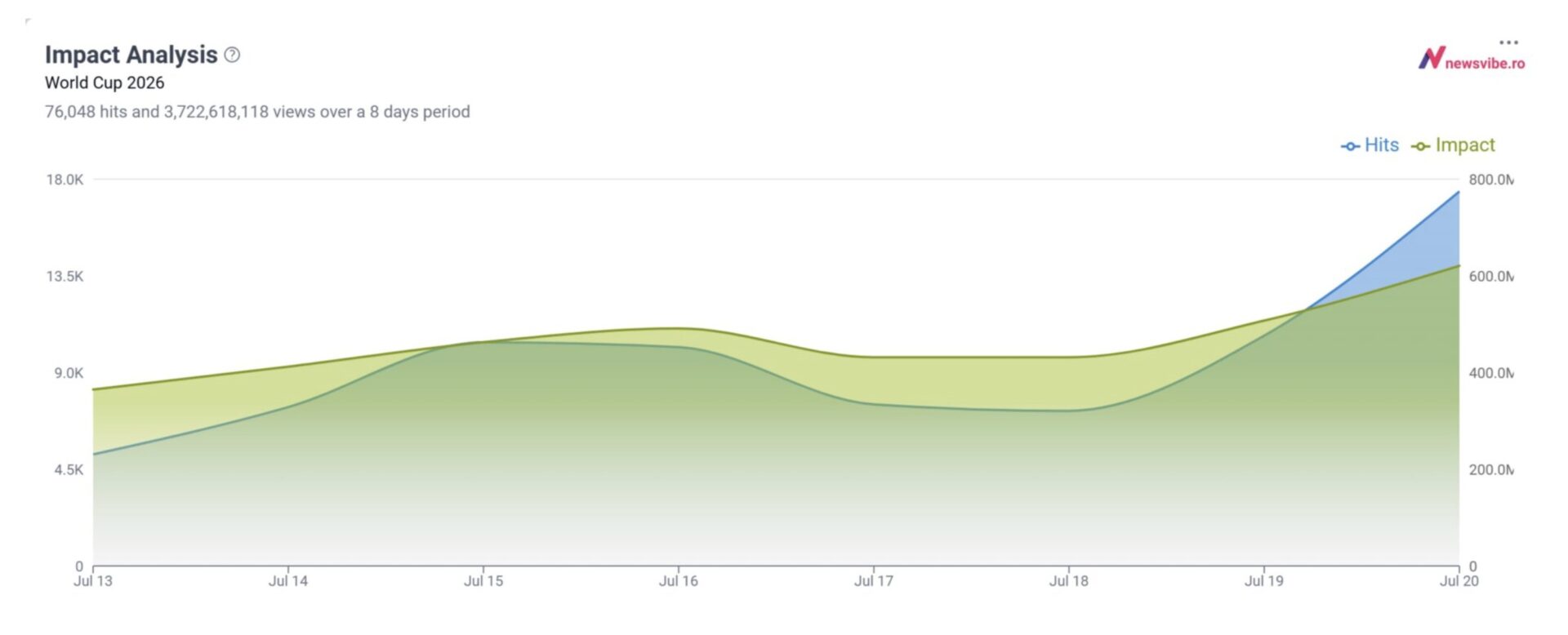
The post-final surge illustrates the media cycle of a global event. Match day is dominated by live coverage, updates and immediate reactions. Over the following hours, the conversation expands into analysis, tournament reviews, player profiles, controversies and related incidents.
Volume and impact did not move at the same pace. On July 20, the number of mentions increased by almost two thirds compared to the previous day, while impact rose from approximately 508 million to 620 million. The topic spread across a wider range of sources, without a proportional increase in the average audience of each item.
The final was the most positive moment. The following day was the most complex
Overall, the conversation had a favorable profile: 32,545 positive mentions (42.8%), 29,186 neutral mentions (38.4%) and 14,311 negative mentions (18.8%). The NewsVibe sentiment score reached its highest level, 0.51, on the day of the final. On July 20, when volume hit a record high, the score fell to 0.43.
The distinction matters: the final was received predominantly as a positive conclusion, but the expansion of the conversation on the following day brought more refereeing debate, politics, incidents and conflict into the mix. Although the negative share remained relatively stable, the absolute number of negative items increased with the overall volume.
Spain and Argentina dominated the conversation – but in different narrative registers
Semantic analysis shows that Argentina and Spain were the two poles of the conversation. Argentina accumulated 24,095 mentions, while Spain recorded 22,828. Together, the two finalists clearly dominated the media agenda during the period, far ahead of all other sporting entities.
Their similar visibility concealed very different narrative roles. Spain concentrated the discourse around victory, a new generation and Lamine Yamal’s emergence as a defining figure. Argentina attracted a more tense and conflicted conversation, fueled by defeat, Messi’s presence, the semi-final against England, the Malvinas/Falklands controversy and post-final incidents.
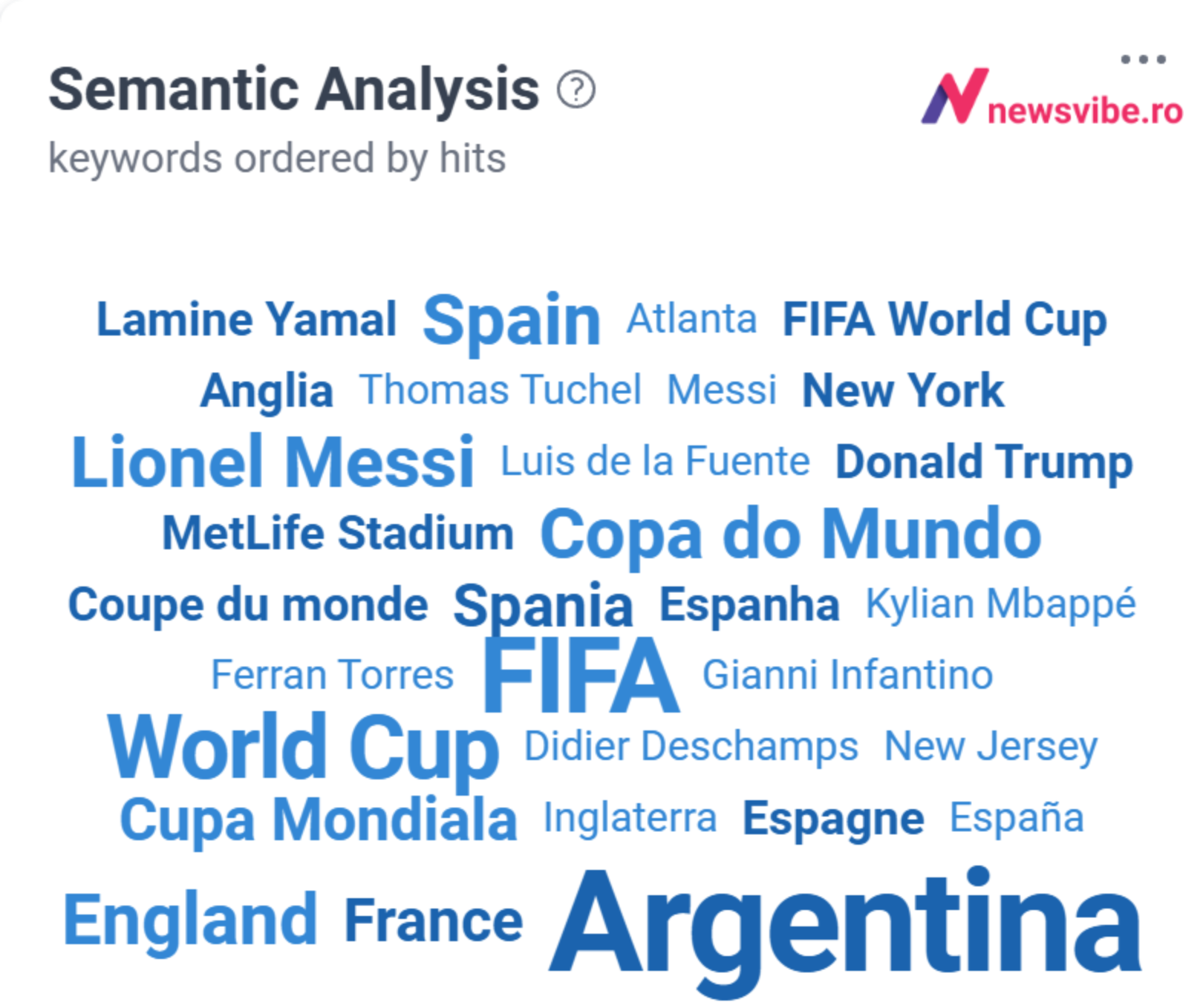
The contrast was also visible in tone: Spain remained predominantly associated with celebration, while Argentina accumulated a larger share of negative mentions. Similar volume therefore did not mean the same kind of visibility: the champions attracted validation, while the defeated finalists attracted narrative conflict.
Argentina sat at the center of the network, even as Spain won the final
Network analysis measures not only frequency, but also the relationships between entities: who appears with whom, and around which actors the story takes shape. In the in-depth July 14-20 window, Argentina was the network’s central hub. Its strongest connections were Argentina-World Cup (5,193 co-occurrences), Argentina-FIFA (4,842), Argentina-Spain (4,582), Argentina-Messi (4,423) and Argentina-England (4,088).
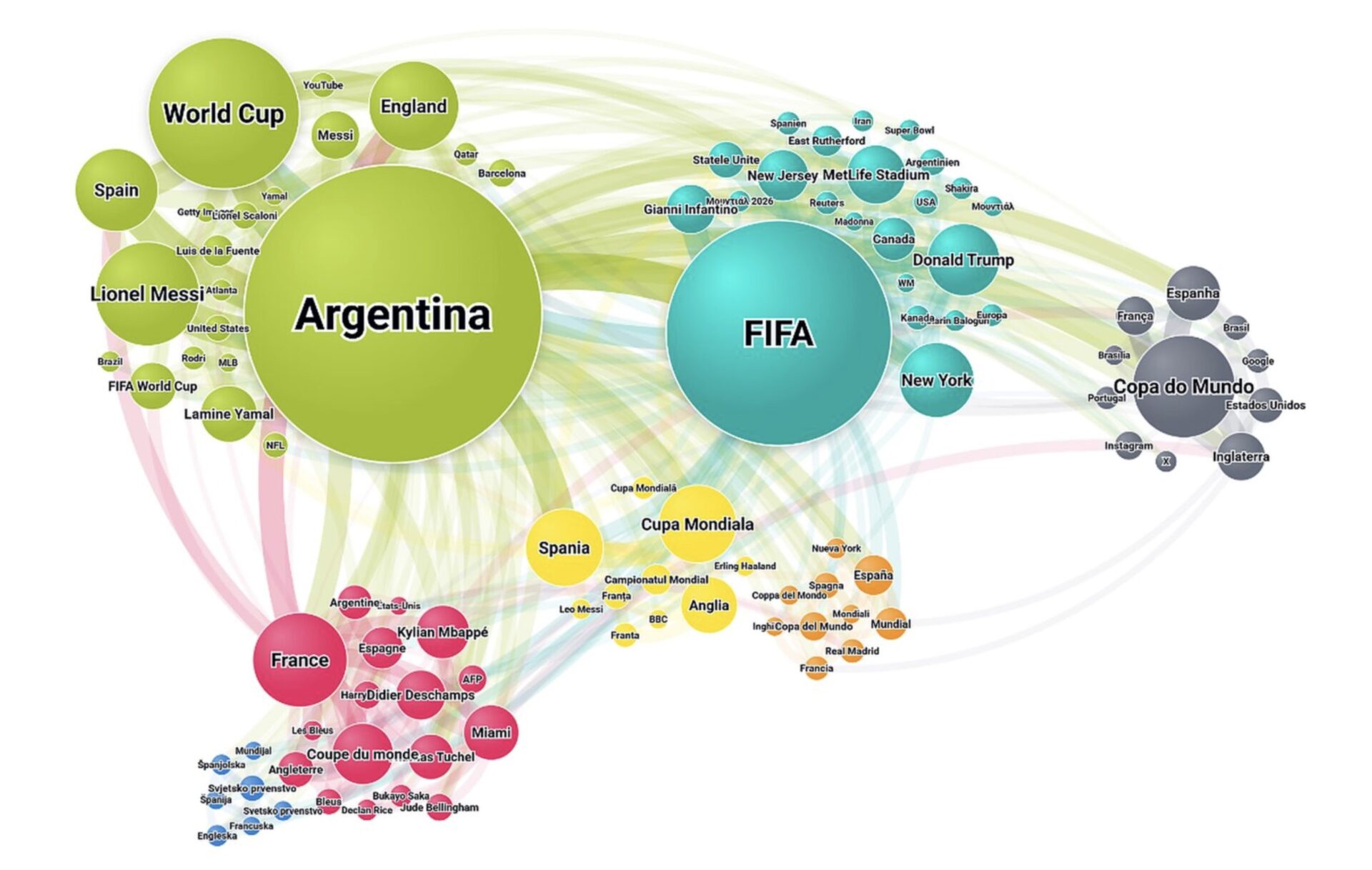
Spain generated a more compact and coherent story: victory, the trophy, Yamal, Torres and a new generation. Argentina produced more narrative extensions, including several that were not directly related to sporting performance. This was the week’s central paradox: Spain won the competition and the positive narrative, but Argentina controlled the complexity of the conversation.
Argentina drove the negative side of the conversation. Messi remained strongly positive
The Sentiment Drivers cloud shows not only who was visible, but also which entities fueled the positive and negative poles of the conversation. Argentina appeared in both registers because of its exceptionally high volume. Even so, with 3,781 negative appearances, it was the most important negative driver among sporting entities. Defeat, player reactions, post-match violence and the Malvinas/Falklands controversy weighed negatively on the team’s image.
The sentiment table records 6,942 positive hits and 688 negative hits related to Messi – still a ratio of roughly ten to one in favor of positive coverage.
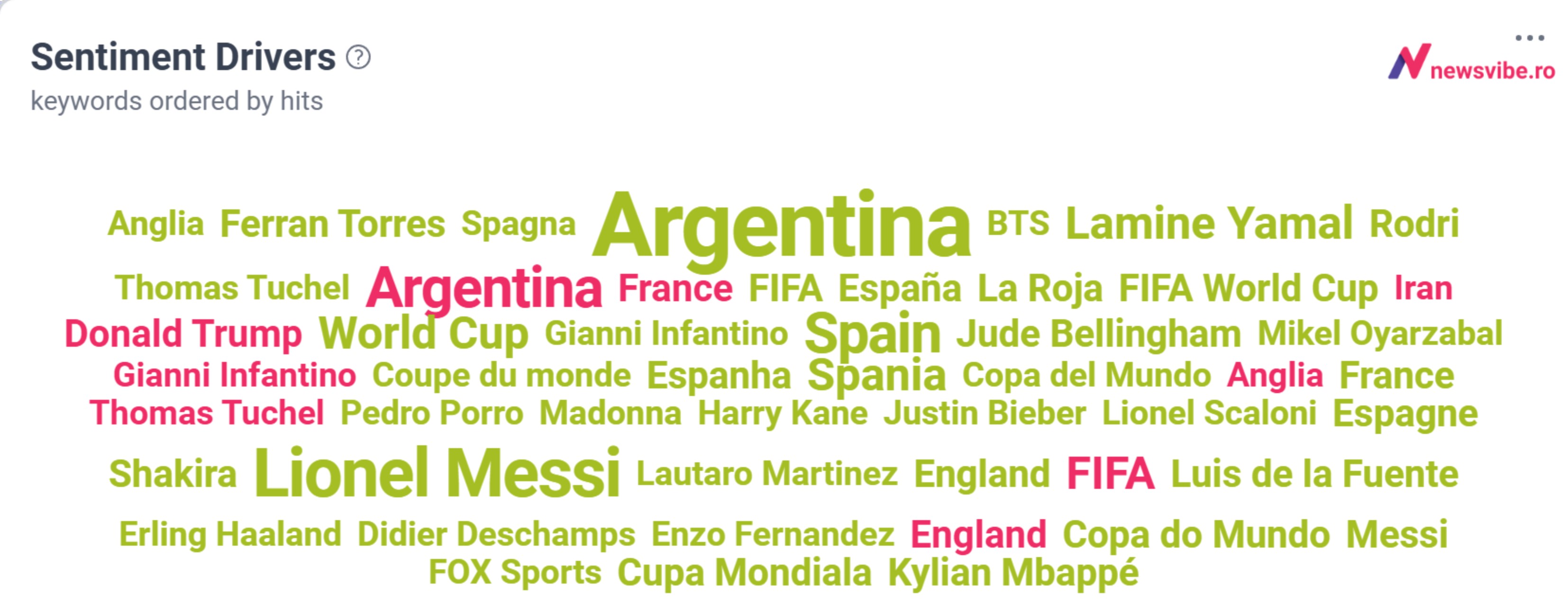
At the narrative level, Argentina and Messi became two distinct entities. Argentina was judged through the match result and the collective behavior associated with the team. Messi was judged through the lens of his entire career and the possibility that the final may have been his last appearance at a World Cup.
The “Messi-final act” narrative encompassed 8,166 articles and registered a sentiment score of +0.49. Rather than producing a blame narrative, the defeat generated a story of farewell, nostalgia and recognition of an extraordinary career.
The players were the positive heroes. Politics did not play well with sports media or fans
The daily sentiment trend confirms the differences between the main actors. Lamine Yamal remained in the most favorable area of the chart and ended the period with a net sentiment of approximately +0.56. Messi also stayed clearly above the conversation average. Argentina remained below Spain, Messi and Yamal, even though the steady flow of sympathetic coverage around Messi prevented its overall score from falling further.
At the opposite end of the spectrum, Donald Trump was the only major actor to remain in negative territory for almost the entire period. His presence at the awards ceremony and alongside the champions’ group photograph transformed the trophy presentation into a political and protocol-driven episode.
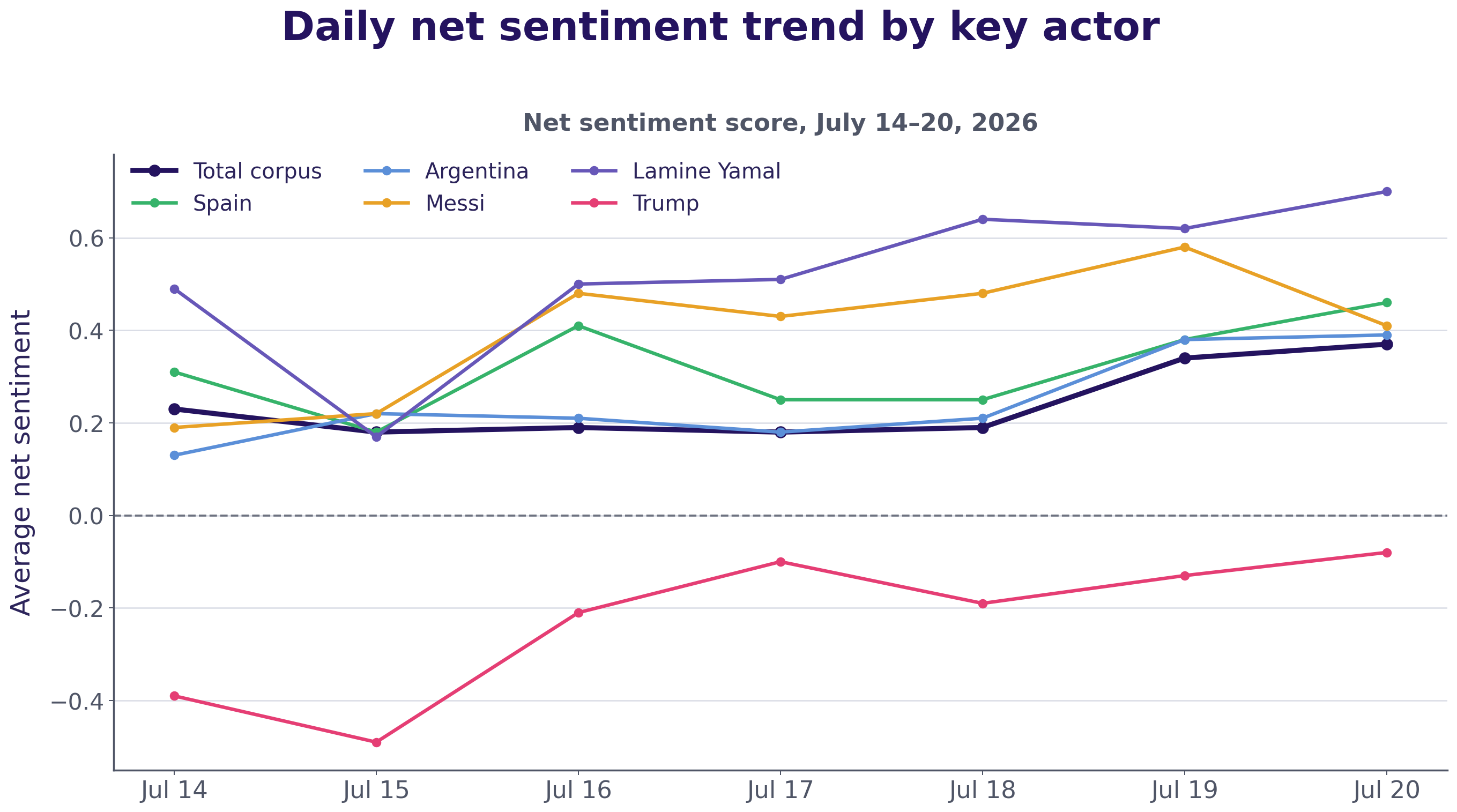
The data points to a complex reflection of Donald Trump: he gained visibility during one of the year’s most-watched sporting moments, but in a context where critical reactions were stronger than favorable ones.
One event, six narrative threads
NewsVibe identified six narratives that structured the week: the Spain-Argentina final, Lamine Yamal, Messi-final act, Trump and the politicization of the final, Slavko Vinčić’s refereeing, and incidents and violence.
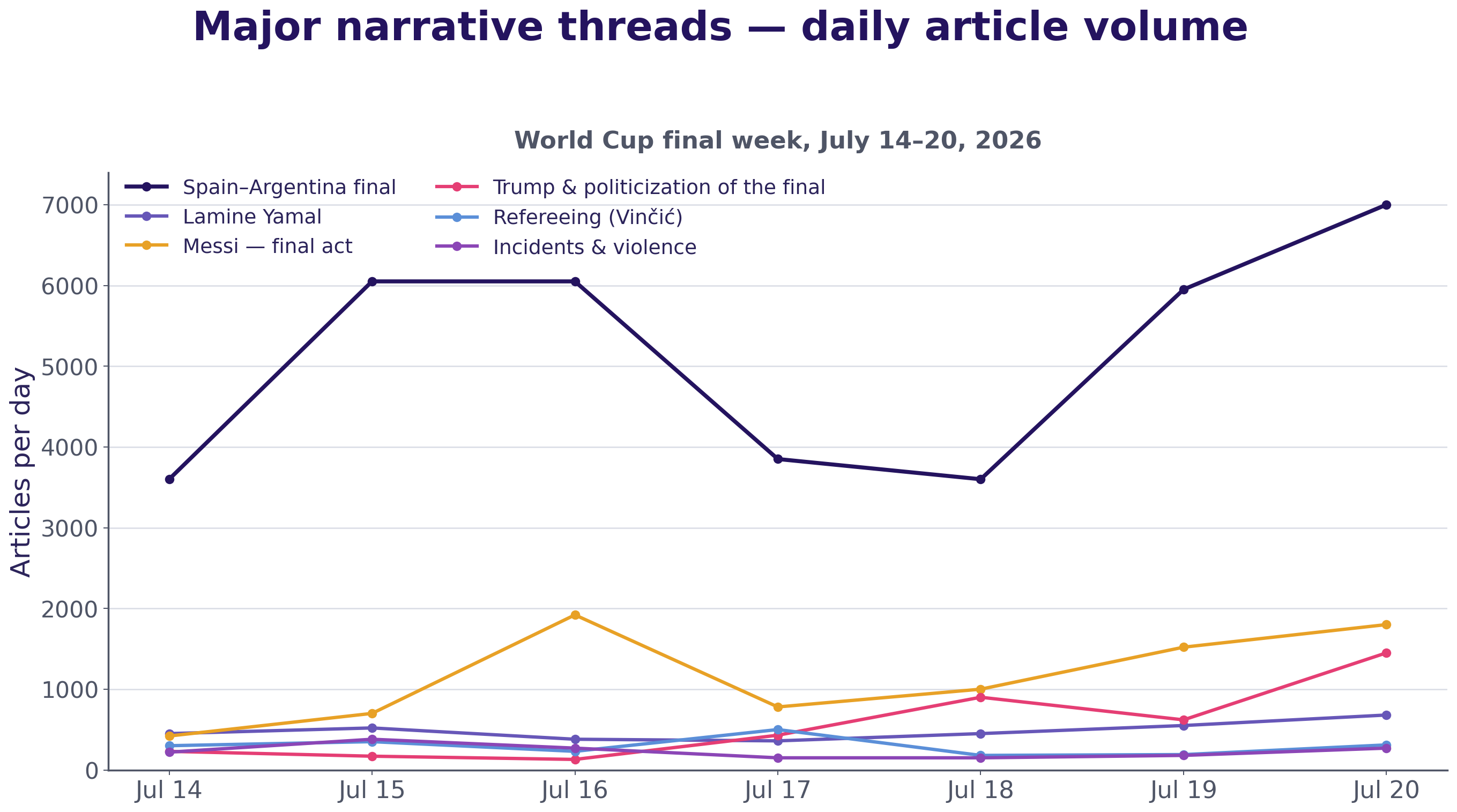
The dominant “Spain-Argentina Final” narrative encompassed 36,084 articles in the in-depth analysis. Three negative satellite narratives developed around it: Trump and the politicization of the final (3,909 articles, sentiment -0.15), refereeing/Vinčić (2,209 articles, 32.5% of them negative), and incidents and violence, with 42.2% negative content.
The Malvinas/Falklands controversy began after Argentina’s semi-final victory over England, when Argentine players displayed a political banner. The issue prompted British reactions and calls for a FIFA investigation, keeping the semi-final in the conversation even after the final. Following Argentina’s defeat, aggressive reactions from some Argentine players and clashes between supporters and police at the Obelisk in Buenos Aires extended the negative cycle.
The negativity was not concentrated in assessments of the football itself. It came mainly from the political, institutional and social context built around the tournament.
Ferran Torres: from supporting actor to global hero
The acceleration chart shows who entered the conversation suddenly during the final three days of the analysis period. Ferran Torres remains the clearest sporting breakout: his visibility increased by more than one hundredfold between the early and late windows. His decisive goal transformed him almost instantly from a supporting actor into one of the tournament’s global protagonists.
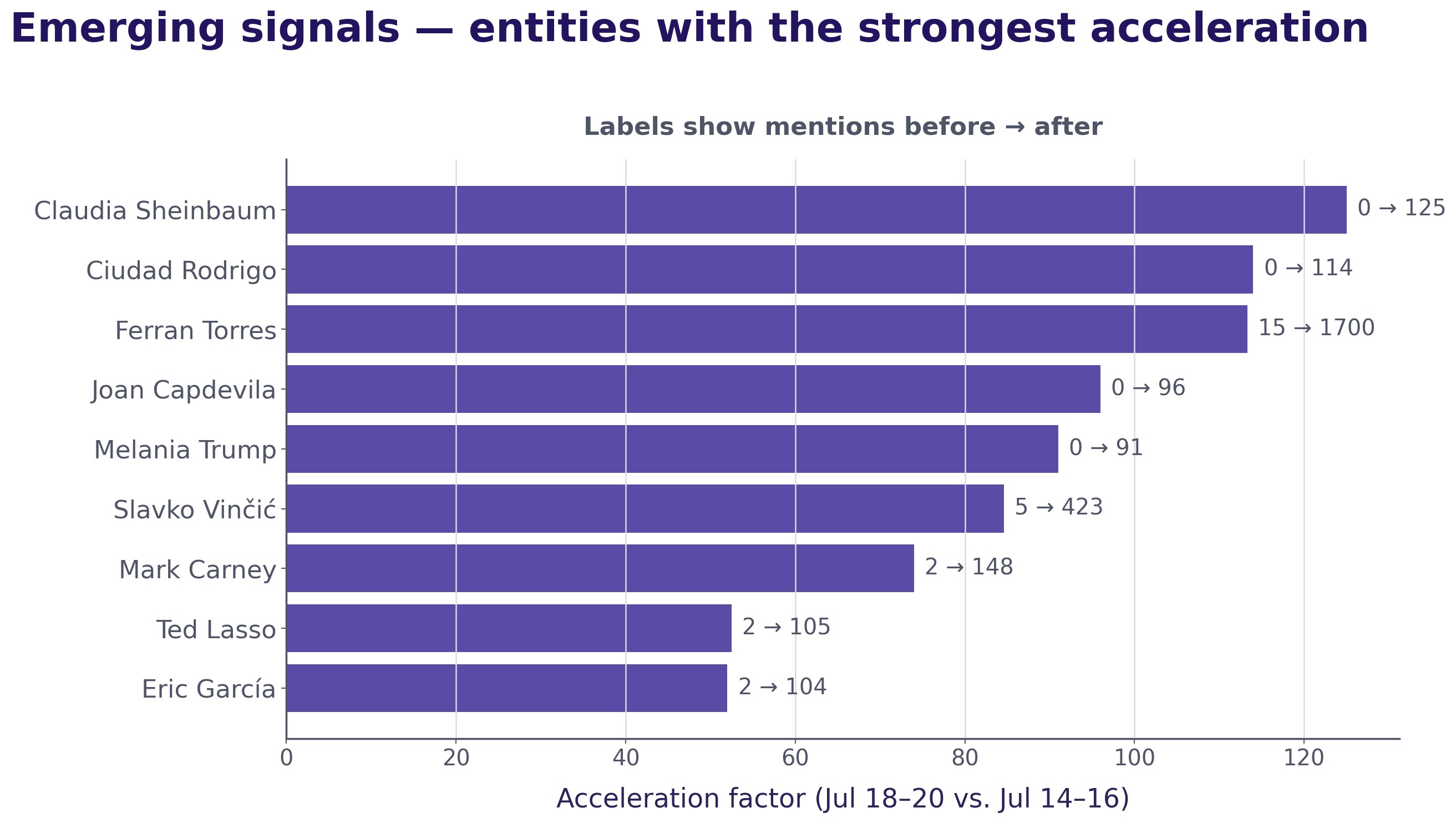
Alongside Torres, three types of emerging visibility can be identified: sporting, through Ferran Torres, Eric García and Joan Capdevila; political and protocol-related, through Claudia Sheinbaum, Melania Trump and Mark Carney; and controversy-driven, through referee Slavko Vinčić. The referee rises from 5 mentions in the early window to 423 in the late window-an acceleration of more than seventyfold.
This type of analysis captures not only who is visible, but who is beginning to matter. Volume rankings identify already established actors; acceleration reveals the conversation’s next protagonists.
Media markets interpreted the tournament through their own results
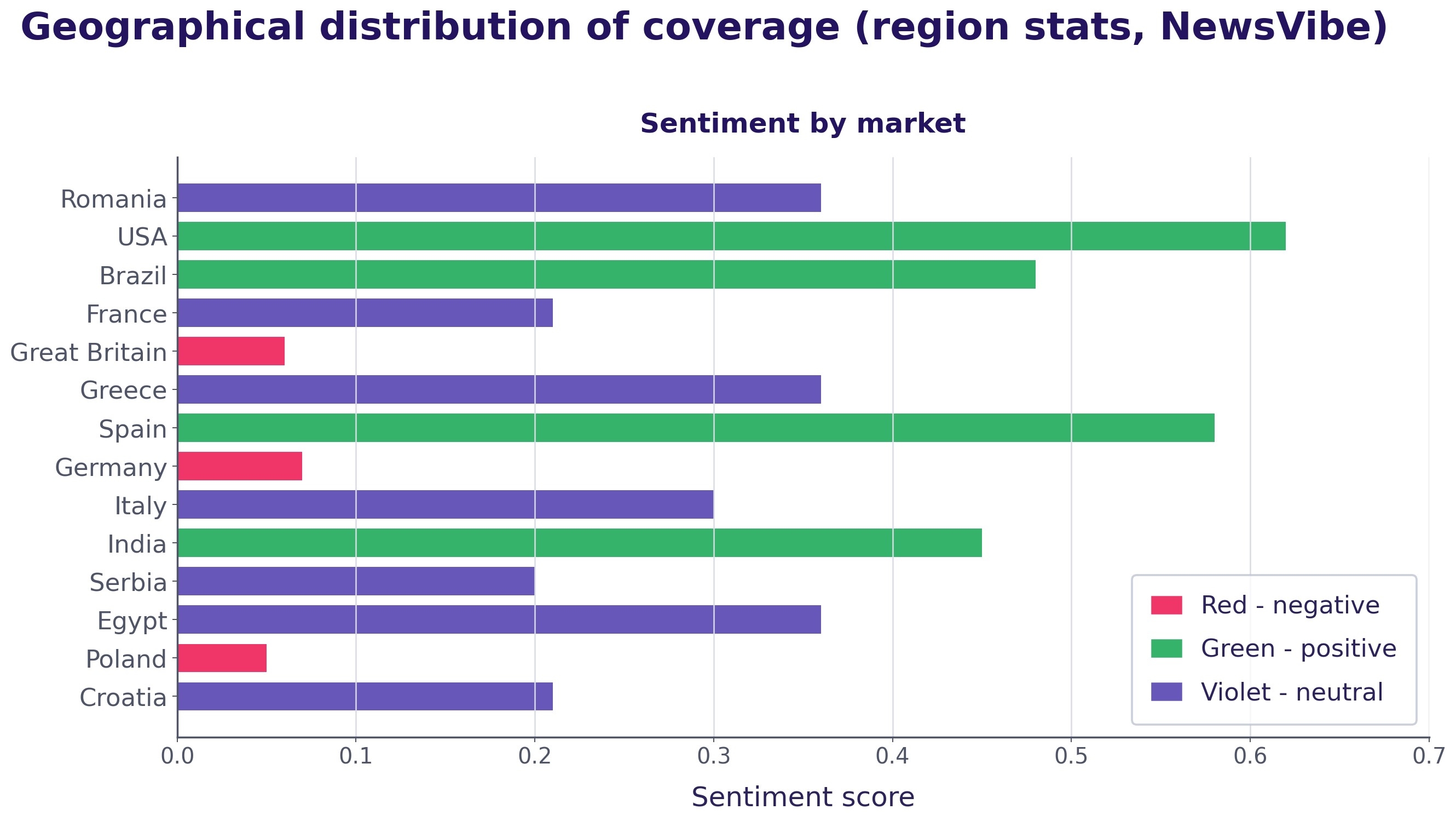
The geographic distribution of mentions and sentiment scores reveals a clear emotional effect. The United States, as host nation, recorded a sentiment score of 0.61, while Spain reached 0.57. Brazil, with no direct stake in the final, also remained in favorable territory at 0.47. Online sources in European countries outside the final had much cooler tones: Great Britain 0.05, Germany 0.06, Poland 0.05 and France 0.21. Romania recorded a sentiment score of 0.36, reflecting coverage focused primarily on the spectacle and the tournament’s star figures, in the absence of a direct national stake.
So who actually won the World Cup in the online competition?
Spain won the trophy and the celebratory register. With 22,828 mentions, the champions were one of the conversation’s two dominant poles and the main beneficiary of positive sentiment.
Argentina lost the final, but remained the structural center of the story. It attracted the largest volume of negativity among sporting entities and was simultaneously associated with Messi, England, FIFA, the Malvinas controversy and post-final incidents.
Lionel Messi was narratively separated from the team. Defeat did not significantly damage his symbolic capital: the coverage around him remained admiring, melancholic and predominantly positive.
Lamine Yamal was the positive hero of the new generation, while Ferran Torres was the greatest beneficiary of the decisive moment, moving within hours from marginal visibility to global-protagonist status. Donald Trump and FIFA absorbed the institutional and political negativity of an otherwise favorable corpus.
NewsVibe: the lens that sees what others miss
Large-scale sporting events like the FIFA World Cup generate a volume and velocity of online conversation that traditional media monitoring cannot fully capture, spanning tens of thousands of sources across dozens of countries and languages within a matter of days. NewsVibe is built for exactly this kind of challenge: it combines real-time media monitoring, entity-level sentiment analysis and narrative tracking to reveal not just how much a topic is discussed, but who the central actors are, how sentiment shifts around them day by day, and which storylines – sporting, political or social – end up shaping public perception. As a media intelligence and brand monitoring platform, this makes NewsVibe a practical tool for understanding the media impact of major global events as they unfold – for brands tracking their exposure, public figures managing reputation, media teams following the story, and researchers studying how narratives form – rather than only after the fact.
