

The first three-way meeting between Donald Trump, Vladimir Putin and Xi Jinping produced a short declaration and a much larger image contest. Online coverage around the world agrees that the pictures from Shenzhen mattered more than the text. It disagrees on who came out ahead.
The leaders met for an hour and a half on 19 November, on the sidelines of the APEC summit in Shenzhen, and adopted a four-point “declaration of peace”.
NewsVibe tracked 22,166 online mentions of the three leaders together between 14 and 20 November, across web, Facebook, YouTube and TikTok. That is thirteen times the volume of the previous seven days (1,699 mentions), with an estimated 1.33 billion views.
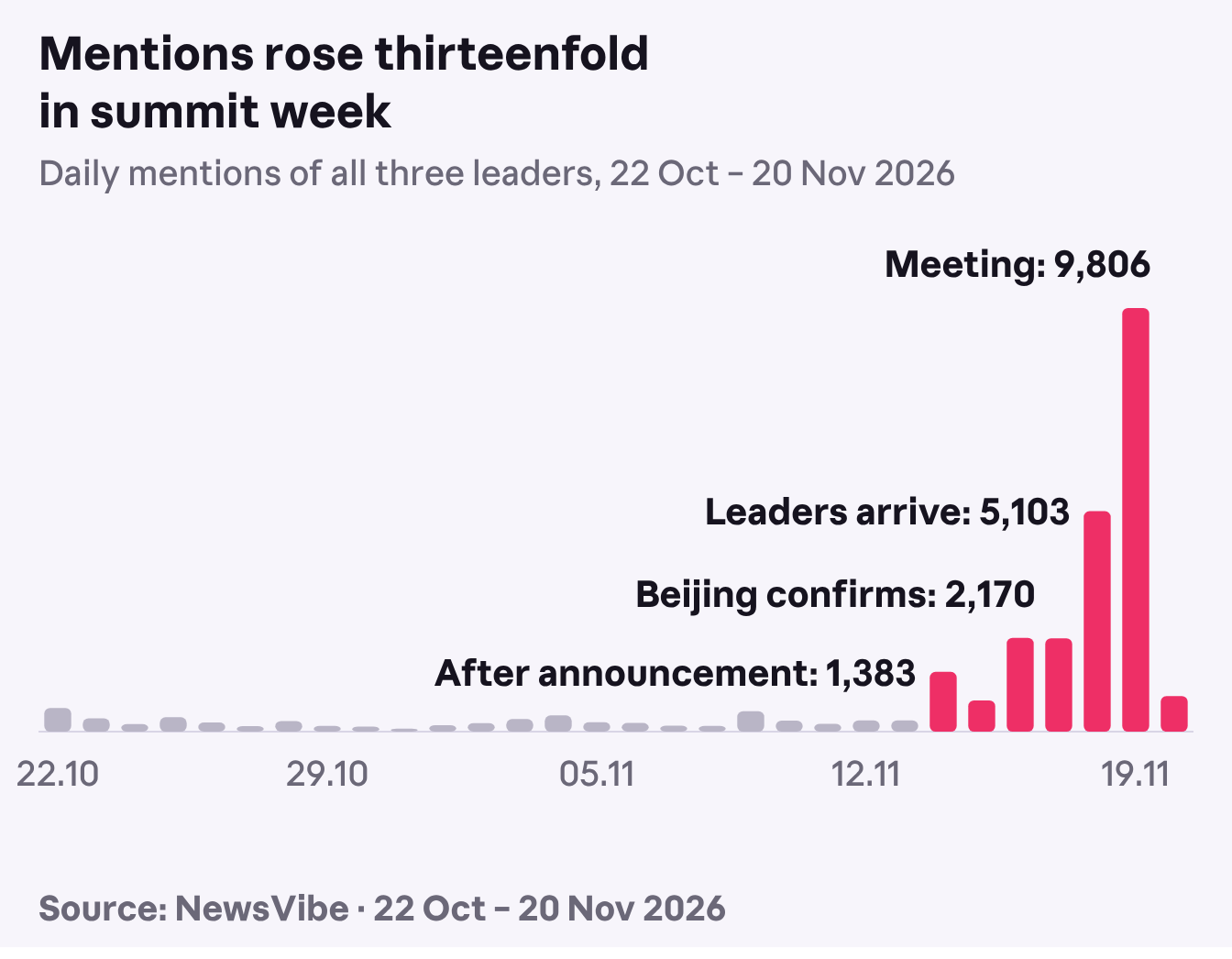
Volume rose in steps: the White House announcement late on 13 November, Beijing’s confirmation on 16 November, the leaders’ arrival on 18 November and the meeting itself, which drew 9,806 mentions on 19 November.
Context: the Shenzhen declaration and the first reactions
The declaration is short and general. According to media reports, its four points cover:
- reform of the United Nations, which the three countries back as permanent members of the Security Council;
- more fuel on the world market and a stable energy supply;
- talks on reducing nuclear risks and preventing proliferation;
- a warning that the International Criminal Court and similar bodies must not abuse their jurisdiction.
Ukraine, Iran and Taiwan are not mentioned. The text was first published by the Kremlin and Chinese state television, and no concrete breakthrough was announced on any of the major conflicts.
In the following hours, the debate moved to Europe. Trump had greeted Putin at the summit as “my friend”. Polish Prime Minister Donald Tusk answered on X: “God, protect us from such friends.” In Berlin, where Ukraine’s allies met a few hours after Shenzhen, German Chancellor Friedrich Merz called the summit “above all a photo op” and warned that a Yalta format would not bring peace.
Sentiment by region: negative in Europe, balanced in Russia
Overall sentiment in the summit coverage was negative (−0.27): 68% of mentions were neutral, 23% negative and 9% positive. The split by region is sharper than the total suggests.
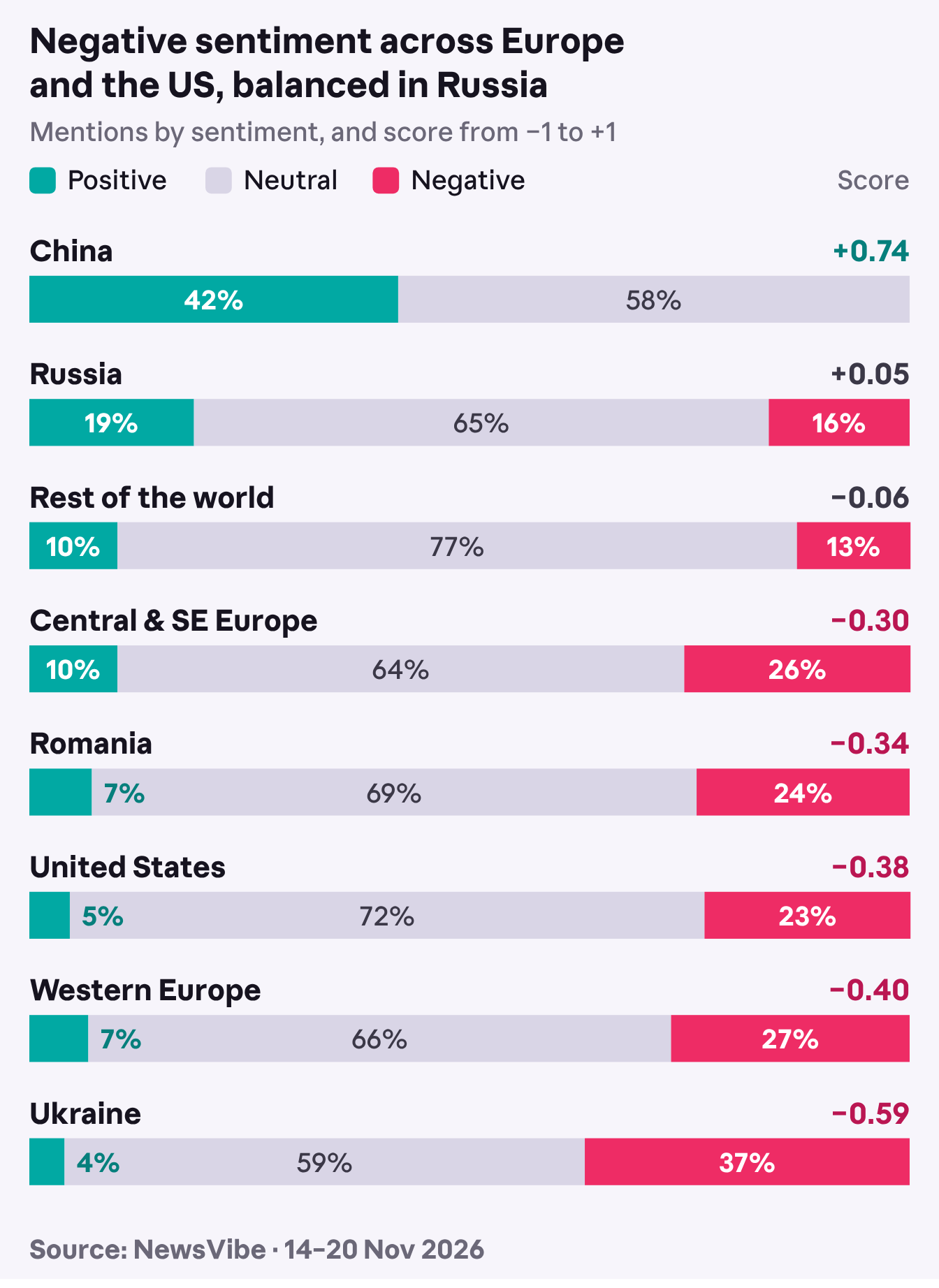
Ukraine had the most negative coverage, with 37% negative mentions. The US, Western Europe, Romania and Central and South-Eastern Europe sit within a tenth of each other, between −0.30 and −0.40. Russian coverage was close to balanced, and Chinese state media had no negative mentions of the summit at all.
NewsVibe · Country and region filters
All the regional figures in this article come from a single search, split by country in NewsVibe. The same set-up lets a communication team see in one view how a product launch, a campaign or a crisis plays out in every market where it operates.
Who won on image: Xi
Xi Jinping is the only leader treated positively more often than negatively in every region analysed. NewsVibeAI scores the sentiment towards each leader separately from the overall sentiment of an article, so a critical article can still treat one of the three favourably.
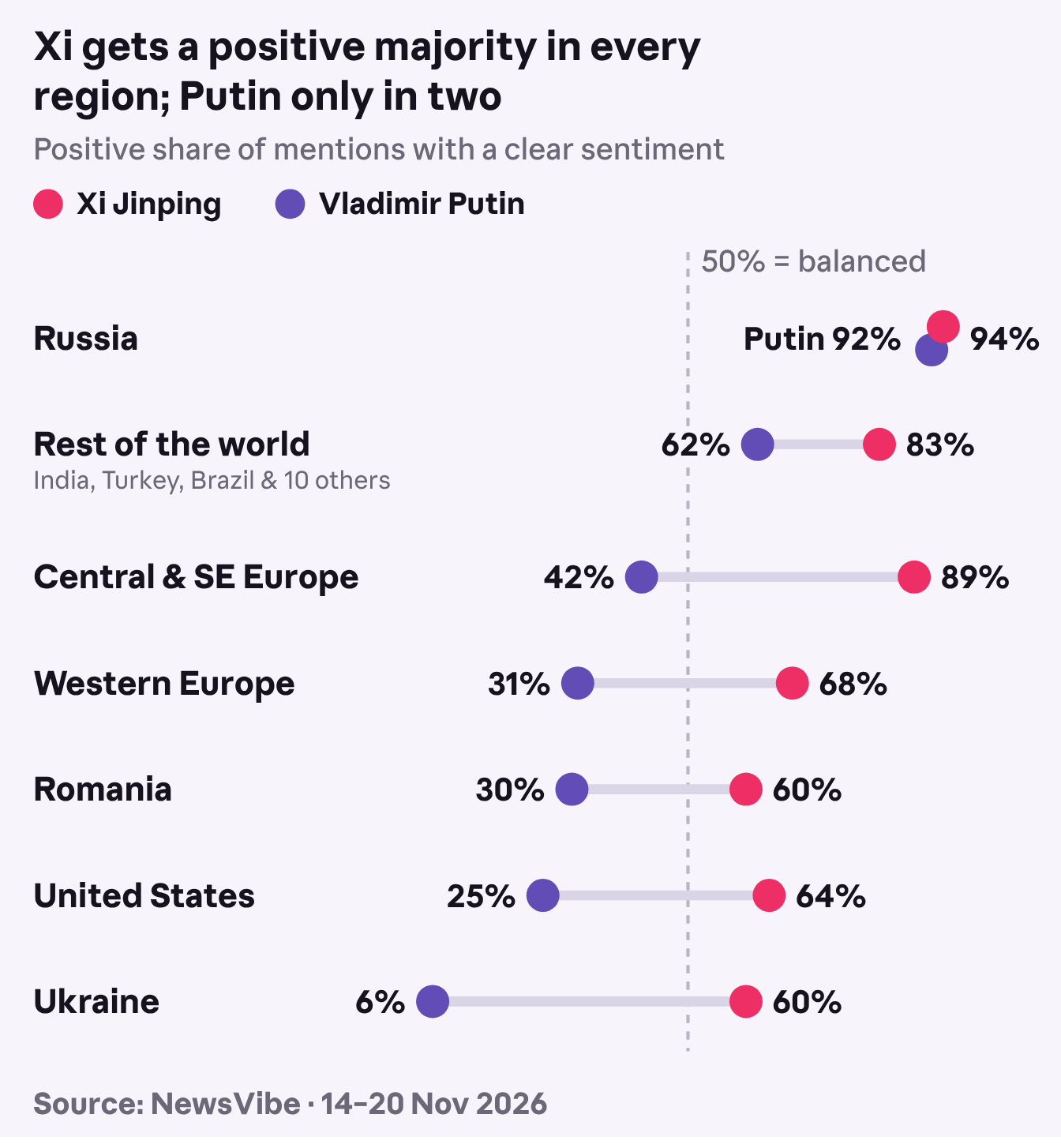
Xi’s positive share ranges from 60% in Ukraine and Romania to 94% in Russia, and in Chinese state media none of the three leaders had a negative mention. Putin gets a positive majority only in Russian online media (92%) and in the rest-of-the-world group (62%). In Ukraine, just 45 of 716 mentions with a clear sentiment towards him are positive.
Trump is treated best in Russian sources (78% positive) and in the rest-of-the-world group (67%). He fares worst at home: 28% positive in US coverage.
NewsVibe · Entity-level sentiment
This entity-level reading is the difference between knowing that coverage was negative and knowing who it was negative about. A story about a crisis can still treat a company’s CEO favourably, and NewsVibe shows both.
US online media: the summit as one stop on Trump’s Asia tour
US coverage leaned negative but stayed largely factual: 2,276 mentions, sentiment −0.38, with 72% neutral and 23% negative mentions. American outlets placed the meeting within Trump’s Asia trip, alongside the stopover in Manila, Xi’s welcome at the airport and a possible meeting with Kim Jong Un. Europe does not appear as a theme of its own.
NewsVibe · Smart Topics
The themes for each region come from Smart Topics, which groups mentions into stories automatically. It shows what each market talked about, in addition to how much it talked.
The main storyline was neutral. The negative clusters came from around the summit: the Kerch bridge strikes, domestic criticism of Trump and commentary on the leaders’ body language. Outlets split sharply. HuffPost (−0.71) and The Daily Beast (−0.96) were among the most critical sources, while Fox News was negative on its website (−0.62) and positive on YouTube (+0.61).
NewsVibe · Channel analysis
NewsVibe tracks web, Facebook, YouTube and TikTok separately, which is how gaps like Fox News’s become visible: the same newsroom can tell its website readers and its video audience different stories.
Western European online media: Putin’s threats and the Berlin meeting
Western European coverage (UK, Germany, France, Italy, Spain) had almost the same sentiment as the US: 3,512 mentions, −0.40, with 27% negative mentions. The stories were different. Two of the largest themes were about Europe’s place: Putin’s threats towards Europeans (−0.56) and the Berlin meeting of Ukraine’s allies, together with the question of further aid (−0.57). The only positive themes were Xi’s welcome for Trump and the backstage stories from Shenzhen.
Western Europe is not uniform. Germany (−0.56) and the UK (−0.50) were close to the Ukrainian level, with France (−0.45) not far behind, while Italy (−0.23) and Spain (−0.18) stayed nearer to neutral. The gap is widest for Trump: 57% of mentions with a clear sentiment towards him were positive in Italy and 54% in Spain, against 18% in Germany.
With almost identical sentiment, the US and Western Europe told different stories. Europe itself is where they part most.
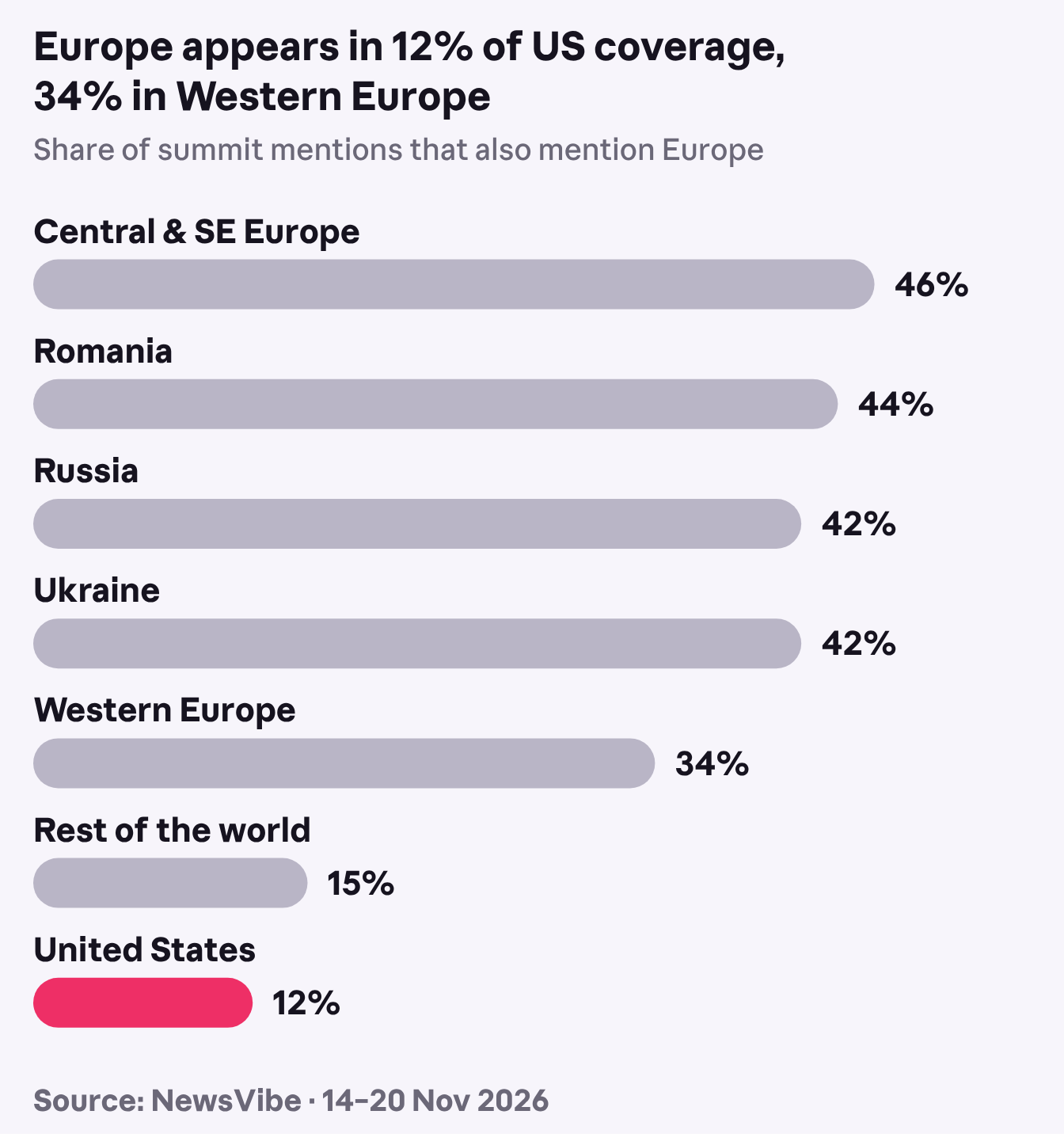
On Europe, Yalta and Ukraine, US coverage looks closer to the rest of the world than to Europe: Yalta appears in 7% of US mentions against 18% in Western Europe, and Ukraine in 36% against 53%. Russian media mention Europe nearly as often as Eastern European media do, but with the opposite tone towards the summit.
Russian online media: the Kremlin’s statements, turning positive in Shenzhen
Russian online media monitored by NewsVibe, especially state and pro-Kremlin outlets such as RIA Novosti, Vzglyad and Lenta, were close to balanced: 2,627 mentions, sentiment +0.05, with 19% positive and 16% negative. The shift came with the leaders’ arrival in Shenzhen: daily sentiment moved from −0.28 on 17 November to +0.20 and +0.24 on the next two days.
NewsVibe · Sentiment Dynamics
Turning points like this one show up in Sentiment Dynamics, which follows the sentiment score day by day for any subject, country or channel.
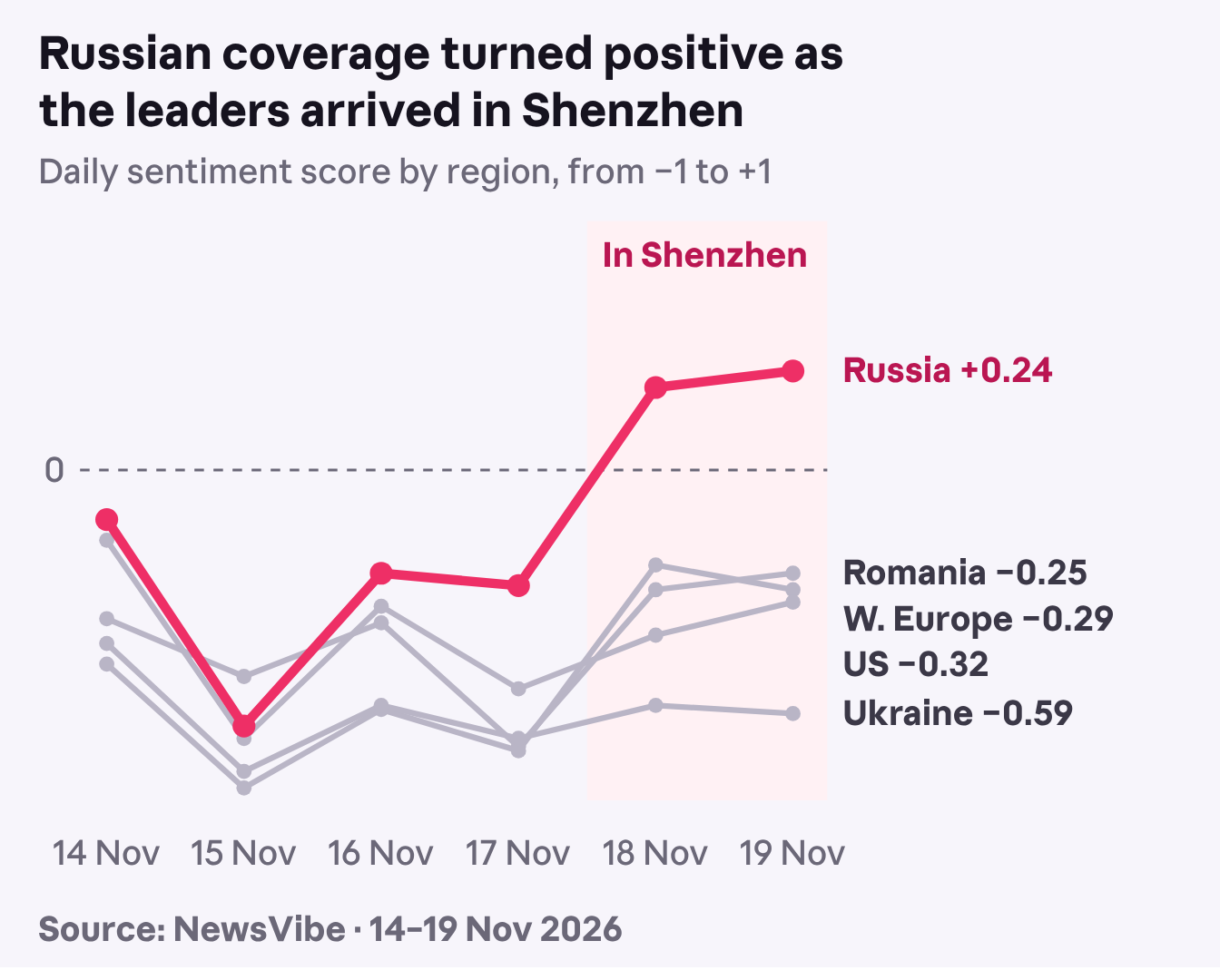
Over 40% of the coverage relays procedural statements from Kremlin aide Yuri Ushakov and spokesman Dmitry Peskov. The most positive themes were the preparations for the joint statement drafted with Beijing, Putin’s own messages at the summit, and Chinese Foreign Minister Wang Yi’s description of the meeting as a “new paradigm” of coordination.
The negative sentiment is aimed outward: at Ukraine, the EU and “the West”. Negative themes covered the strikes on the Crimean bridge, Ukraine and the negotiations, and the summit as a signal that Europe should revise its policy.
Chinese state media: APEC as Beijing’s showcase
The Chinese sources in this analysis are mostly English-language outlets for international audiences: state media such as CGTN, Xinhua, China Daily and Global Times, and the Hong Kong-based South China Morning Post.
Across all foreign-policy topics that week, not only the summit, their coverage was strongly positive (+0.75, with 60% positive and 6% negative mentions). South China Morning Post was the more reserved exception (+0.19).
The trilateral meeting was the fourth-largest theme in that coverage (109 mentions, +0.77), framed as a historic first for world stability. The larger stories were APEC in Shenzhen as a showcase of China’s openness, Xi’s speech to the summit and his bilateral meetings. Xi called the summit “positive, constructive and fruitful”.
Ukraine, Central Europe and the rest of the world: the war, the declaration and the spectacle
Ukraine had the most negative coverage of any region: 1,596 mentions, sentiment −0.59, with 37% negative mentions. The largest theme was live video commentary on YouTube (−0.77). Almost every theme tied the summit to the war: the Crimean bridge strikes, President Zelensky’s view that Trump and Xi could force Putin to end the war, and the attacks on Kyiv and Odesa during the summit days. The declaration was noted mainly for what it left out, Ukraine. A new theme on 19–20 November followed Politico’s report that Trump questioned further military aid (−0.98).
Central and South-Eastern Europe (3,953 mentions, −0.30) was largely factual, and treated the joint declaration positively: both its line that a nuclear war cannot be won (+0.23) and the four-point “declaration of peace” (+0.58). Czech and Hungarian outlets asked whether the meeting was truly historic or only looked that way. Poland’s Fakt reported that Europe had no voice in the talks.
In the rest of the world (1,777 mentions from 13 countries, China excluded), coverage was mostly neutral (77% neutral, sentiment −0.06). Indian outlets treated the summit as spectacle: viral moments, handshakes, the family photo. The Times of India also offered the bluntest scepticism: good photos, few results. Brazilian media stressed that the idea of the meeting came from President Lula, as Canadian Prime Minister Mark Carney had said days earlier, and picked up Merz’s description of the summit as a photo op. Japanese and Korean coverage focused on nuclear disarmament, the Yalta comparison and North Korea.
Romanian online media: Putin’s post-summit remarks and the risks for Romania
Romanian online media gave the summit more room than most of Europe: it took up 18.9% of their foreign-policy coverage, fifth among the countries measured and behind only Russia, Italy and Germany in Europe. Sentiment was negative (−0.34), close to the US and Western European levels: 2,990 mentions, 24% negative and 7% positive.
The main storyline was close to neutral (−0.07). HotNews summed up the summit as having little substance but a clear gain for Russia and China. The negative sentiment came mostly from Putin’s post-summit remarks (−0.68), praising the Yalta agreement, attacking EU leaders and threatening retaliation for the Kerch bridge strikes. The Yalta comparison itself was debated: former president Traian Băsescu argued that the stake was not a division of the world, while other outlets asked whether Shenzhen was a “Yalta 2.0”.
Romania also had a theme of its own, absent from the other regions: what the meeting means for the country (−0.49), with analyses by Deutsche Welle Romania and Adevărul on the risks for Romania. President Nicușor Dan rejected the “Yalta 2.0” comparison and commented on security guarantees for Europe. Romanian outlets also covered the Berlin meeting, where Merz described the summit as a mere photo op.
Where the summit took up the most space
Measured against each country’s own foreign-policy coverage, the summit mattered most in two of the three participating countries: Russia (24.0%) and the US (23.1%).
NewsVibe · Content Domain filter
Raw mention counts mostly reflect how many sources a country has, so they cannot rank countries fairly. NewsVibeAI assigns every mention to thematic domains, such as Global Politics, so the full foreign-policy coverage of each country in the same week can serve as the baseline. This gives a common reference point for comparing markets of different sizes, whether the subject is a brand, a public figure or a topic.
The ranking below shows what share of each country’s foreign-policy coverage the summit took up: mentions of the three leaders within Global Politics, divided by all Global Politics mentions in that country.
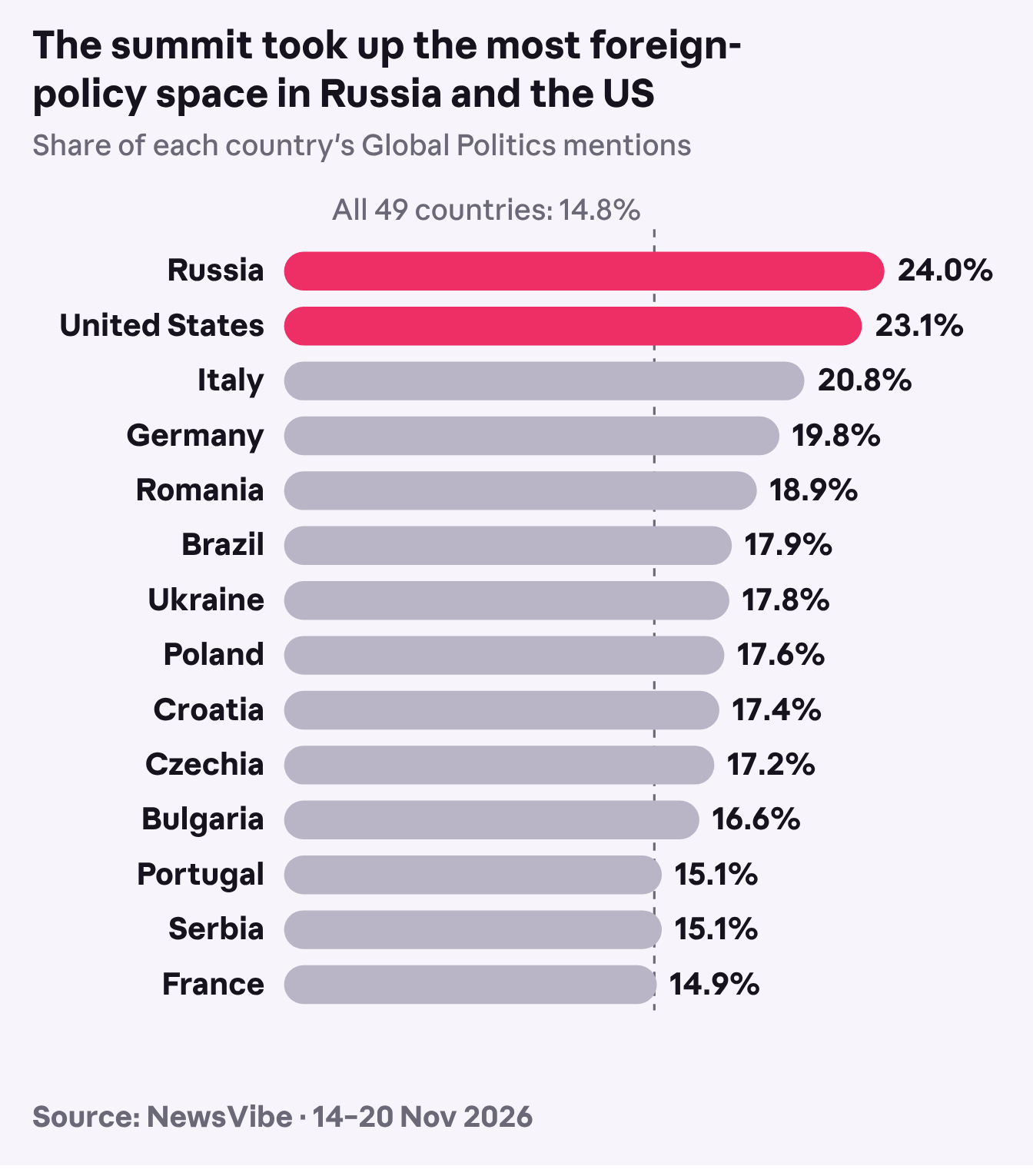
Across the 49 countries with enough coverage to compare, the summit accounted for 14.8% of all foreign-policy mentions. Italy (20.8%) and Germany (19.8%) gave it more space than France (14.9%), while the UK and Spain are not among the top 20. Romania ranks fifth, at 18.9%.
FAQ
What did Trump, Putin and Xi agree in Shenzhen?
A four-point declaration covering UN reform, a stable fuel supply, talks on reducing nuclear risks and a warning to the International Criminal Court. It does not mention Ukraine, Iran or Taiwan.
Who came out of the summit best in online coverage?
Xi Jinping. According to NewsVibe data, he was treated positively more often than negatively in every region analysed, from 60% in Ukraine and Romania to 94% in Russia. Putin had a positive majority only in Russian online media and in the rest-of-the-world group.
How did Russian online media cover the summit?
Largely through the Kremlin’s own statements. Russian coverage was close to balanced (+0.05) and turned positive as the leaders arrived in Shenzhen.
Did US and European media cover the summit the same way?
Their sentiment was almost identical (−0.38 and −0.40), but their stories differed. Europe appears in 12% of US mentions and in 34% of Western European ones.
How did Romanian online media cover the summit?
With negative sentiment (−0.34), close to the US and Western European levels, and with one theme of its own: the risks for Romania. The summit took up 18.9% of Romania’s foreign-policy coverage, the fifth-highest share among the countries measured.
What is sentiment analysis in media monitoring?
It classifies each mention as positive, negative or neutral and aggregates the result into a score from −1 to +1. NewsVibe can also score the sentiment towards a specific person or brand inside an article, separately from the article’s overall sentiment.
How does NewsVibe monitor a global event like this?
It tracks mentions on web, Facebook, YouTube and TikTok in more than 20,000 sources from over 74 countries, which can be split by country, channel and domain. NewsVibeAI scores the sentiment of each mention and of each person or brand within it, and Smart Topics groups the coverage into themes.
Same pictures, different stories: what Shenzhen showed
Online coverage in every region treated Shenzhen as an event of images more than outcomes. Where regions differ is on who won those images. European coverage saw Putin brought back to the table and Europe left outside the room. US coverage, with almost the same sentiment, treated the meeting as a stop on Trump’s Asia tour and rarely mentioned Europe. Russian media relayed the Kremlin’s satisfaction, and Chinese state media presented Beijing as host. Outside Europe, coverage followed the spectacle.
The one reading all regions share is Xi’s: he left Shenzhen with the most favourable coverage of the three, including in Ukraine and the West.
For anyone managing a reputation across markets, the lesson goes beyond Shenzhen. A single total would have shown 22,166 mentions and a negative sentiment. The real picture appeared only once the coverage was split by country and channel, sentiment was scored for each leader and mentions were grouped into themes. NewsVibe did all of this from one search, on data collected the morning after the meeting.
These figures cover the coverage up to the morning after the meeting. European reactions, including the Berlin meeting, were only starting to enter the data, so the balance may still shift.
NewsVibe · Alerts
With NewsVibe Alerts, a team following a story like this is notified when its volume or impact crosses a set threshold, and can follow it as it moves across countries, channels and sentiment. You can test it on your own subjects with a 7-day free trial, no credit card required.
